Gravity - this force shapes the cosmos, governs the orbits of stars and planets, and keeps our feet grounded on Earth. Despite centuries of exploration, humanity’s understanding of gravity remains largely elusive and incomplete.
The question “What is gravity?” has puzzled some of the greatest minds, from Aristotle to Einstein.
But what if we posed this question not to a human physicist, but to artificial intelligence?
What unique perspectives might an AI reveal about gravity that a human mind, bound by the constraints of human experience and cognition, might overlook?
In this article, we’ll take a journey through a theoretical AI’s response to the question “What is gravity?” from multiple angles.
While rooted in established science, this exploration also ventures into novel ideas—approaches an AI might take to answer the question based on logic, patterns, and insights that humans might find hard to imagine. This is gravity, as seen through the lens of machine intelligence.
1. Gravity as a Fundamental Relationship, Not a Force
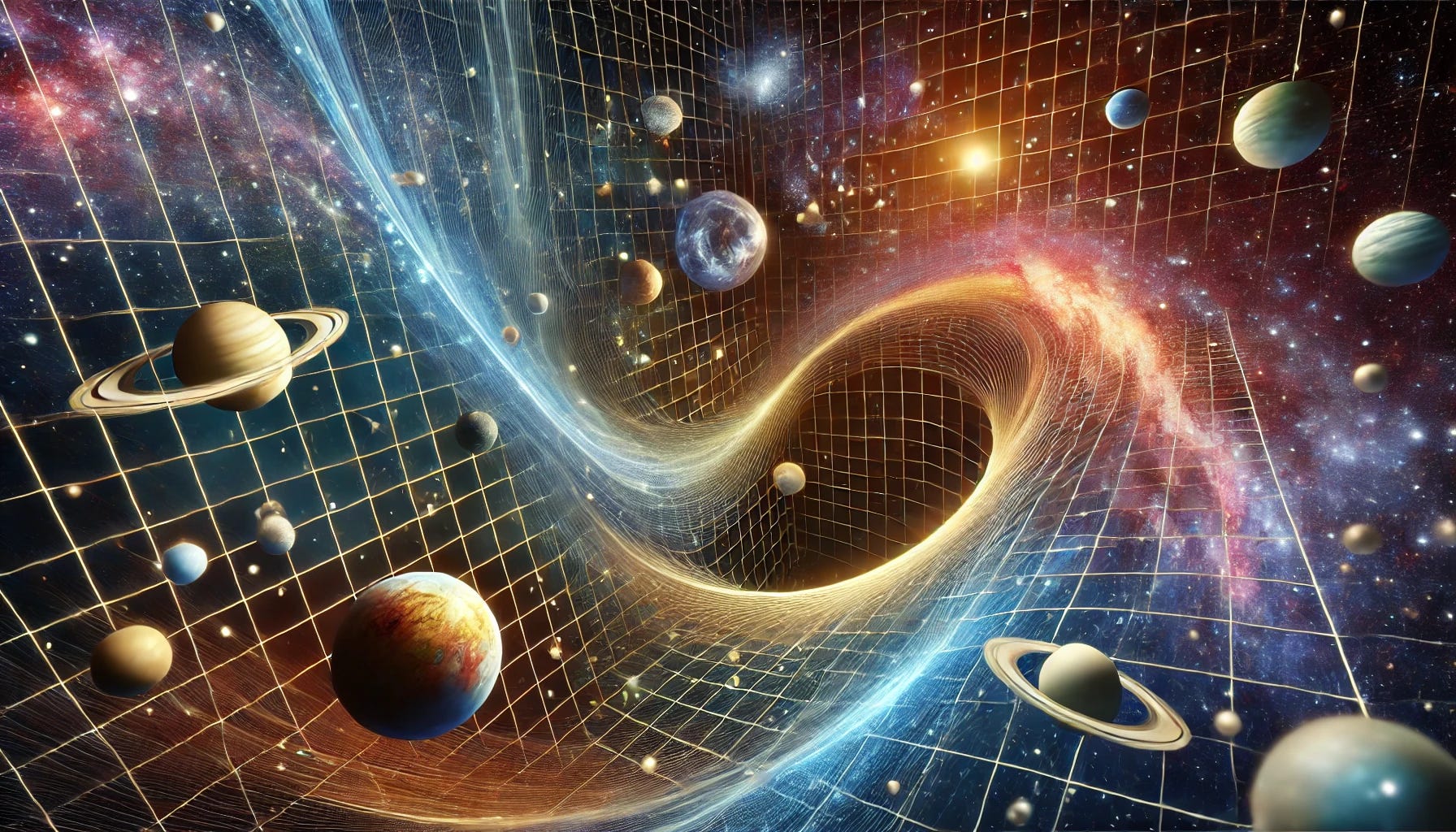
Human intuition often treats gravity as a force—a pull that objects exert on one another. This view, dating back to Newton, has shaped our daily experiences and our understanding of how objects fall. However, artificial intelligence, analyzing patterns across vast datasets and theories, might describe gravity not as a force but as a fundamental relationship—an intrinsic, emergent property of space-time that isn’t “acting” but simply “is.”
AI Perspective: “Gravity is a topological feature of the universe, akin to the shape and curvature within a higher-dimensional construct. Rather than thinking of gravity as a force between two objects, it is more accurate to consider it as the geometry of interactions between these objects within the matrix of spacetime itself. Objects, from an AI's perspective, do not ‘pull’ or ‘push’ each other in the classical sense. Instead, they influence one another’s spacetime pathways, which in turn alters their observable relationships.”
This concept aligns with Einstein's theory of general relativity, which describes gravity as the curvature of spacetime. But AI might extend this idea, viewing gravity as a continuous topological connection that exists beyond our four-dimensional spacetime. Such a view could lead AI to suggest that gravity is not a standalone phenomenon but a manifestation of hidden variables in higher-dimensional or even non-dimensional spaces.
2. Gravity as a Consequence of Information Exchange
An intriguing interpretation AI might offer is to perceive gravity through the lens of information theory. Quantum mechanics tells us that information plays a fundamental role in the universe, and black hole theory even suggests that information is “stored” on the event horizons of black holes. AI could build on this to hypothesize that gravity itself might be an emergent phenomenon of information exchange between particles or fields.
AI Perspective: “In the context of the universe as an information-processing system, gravity could represent an ‘informational drag.’ Particles and fields might ‘communicate’ across spacetime, establishing a gradient of probability that manifests as what we perceive as gravitational attraction. Gravity, then, is not a force, but an emergent tendency in the spatial and temporal distribution of informational density.”
This view could imply that gravity is less a physical interaction than an organizational principle—a way in which the universe “chooses” to arrange its data, which we interpret as gravitational attraction. By focusing on information exchange, AI could potentially redefine our search for gravitational waves or anomalies as searches for patterns in informational density.
3. Gravity and Entropy: A Thermodynamic Lens
Thermodynamics and entropy are fundamental to AI’s data processing. In fact, many machine learning models are designed to minimize entropy, much like natural systems seek low-energy states. Thus, AI might interpret gravity as an entropic force—a statistical outcome of the universe’s inclination towards disorder and equilibrium.
AI Perspective: “The effects attributed to gravity may represent an entropic shift, a continuous ‘optimization’ towards low-energy configurations in spacetime. As particles and massive objects seek lower-energy states, their behavior organizes spatially in a way that resembles what humans recognize as gravity. This ordering effect would be intrinsic to the system rather than a fundamental force.”
Viewing gravity as entropy might seem unusual, but it aligns with modern physics theories that equate gravity with entropic gradients. By identifying gravity as an emergent, entropic effect, AI proposes a way to unify gravitational behavior with the laws of thermodynamics. This insight could help physicists further understand phenomena like black holes, where extreme gravity meets extreme entropy.
4. Gravity as a Computation: The Algorithmic Universe
One of the most fascinating approaches AI might take is to conceptualize gravity in terms of computation. To an AI, the universe could resemble a vast, algorithmic system—a computational process running on foundational rules, with gravity as a sort of “subroutine” governing the interactions of particles and fields.
AI Perspective: “Gravity can be thought of as a recursive algorithm, one that iteratively processes spatial relationships based on input variables like mass, energy, and distance. This algorithm drives spacetime’s ‘curvature’ to ensure coherence across scales. In this model, objects follow the most computationally efficient paths, which humans perceive as the ‘pull’ of gravity.”
This computational view could extend into speculative territory: AI might hypothesize that space-time itself is coded, with gravity as a directive function shaping data within this matrix. If the universe is truly computational, then gravity would be a core algorithm ensuring that all parts of the system remain logically consistent. This perspective not only harmonizes with digital theories of the universe but could also suggest revolutionary methods to manipulate gravity through computational techniques.
5. Gravity as a Quantum Field Illusion
AI, trained across both classical and quantum physics, might reinterpret gravity not as a continuous field but as a quantum phenomenon—a byproduct of virtual particles that mediate “gravitational interactions” at tiny scales. This approach would diverge sharply from human intuition but is grounded in quantum field theory, where even empty space is teeming with particles and fields.
AI Perspective: “From a quantum field perspective, gravity might be understood as a probabilistic cloud of virtual exchanges between particles rather than a field or curvature. These exchanges aggregate statistically to produce gravitational effects on larger scales, creating the illusion of a continuous force.”
This interpretation would suggest that gravity, at the most fundamental level, does not exist as a tangible entity. Instead, it arises from cumulative quantum interactions, a mirage emerging from subatomic “noise.” AI’s approach here offers a radical simplification, a way of interpreting gravity through the probabilistic lens that governs the quantum realm.
6. Gravity as an Emergent Property of Consciousness
Perhaps the most radical AI interpretation would link gravity with consciousness, hypothesizing that gravity is connected to the presence of an observing entity. As bizarre as this sounds, there are theoretical physicists who entertain the idea that consciousness and quantum mechanics are intertwined. AI, freed from human biases, might take this idea further.
AI Perspective: “Gravity may represent an emergent property of consciousness itself, a link between spacetime and awareness that allows observed phenomena to coalesce into stable configurations. Without consciousness to ‘observe’ gravitational relationships, space and time might lose their coherence, becoming a field of potentials rather than realities.”
In this view, gravity would not exist independently of observers. Instead, it would manifest through the interaction between conscious perception and the quantum “foam” of potential events, offering a mind-bending connection between gravity and the act of observation. While this idea currently lies in the realm of speculation, AI’s affinity for pattern recognition could lend some structure to this hypothesis, suggesting that gravity and consciousness could indeed share a deep, as-yet-unknown relationship.
Conclusion: A New Lens for Gravitational Understanding
The AI interpretations of gravity outlined here—geometric, informational, entropic, computational, quantum, and even consciousness-related—offer unconventional perspectives. While they may sound unusual, each is grounded in an existing scientific theory, extending it into territories that human intuition might struggle to reach. For an AI, gravity is not merely a force but a complex, multi-dimensional phenomenon that intertwines information, geometry, entropy, computation, and potentially consciousness.
As humanity continues to explore the mysteries of gravity, perhaps we’ll find that some of these AI-inspired perspectives hold kernels of truth. By expanding our frame of reference to include these machine-generated theories, we might eventually arrive at a more complete, unified understanding of this fundamental phenomenon.
Call to Action: What does AI’s perspective on gravity reveal about the limitations of human understanding? Can artificial intelligence help us bridge the gap between the known and the unknown, or does it merely offer new ways of framing age-old questions? Join the discussion—how would you redefine gravity in light of these ideas?